![[awatar]](/static/gen/avatars/westoncrowe/m0.png?3 "WestonCrowe")
Bitcoin casino list
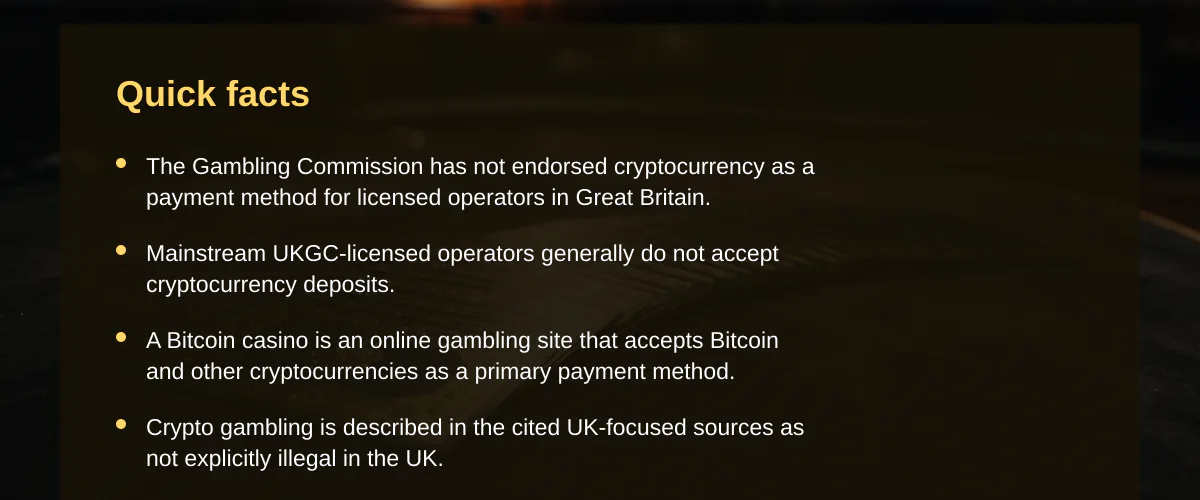
I play on the smallest stakes I can find, so a bitcoin casino list is exactly the sort of thing I read carefully. These lists gather sites that accept Bitcoin and other crypto as a primary way to deposit and withdraw. For players in the United Kingdom this is a niche that needs extra attention: the Gambling Commission has not endorsed cryptocurrency as a payment method for licensed operators, and mainstream UKGC-licensed operators generally do not accept crypto.
That said, a lot of UK-facing lists show offshore options that accept crypto, often under Curaçao eGaming licences rather than UKGC licences. Those lists commonly show coin options and tiny minimums, and they sometimes advertise very fast withdrawals — under one hour to under two hours for certain coins and networks. I’ll walk through what those entries mean for someone playing on minimum deposits, and what I check before I risk even a small amount of Bitcoin.
I’m frugal with my bankroll and I want to know two things up front: what the smallest deposit actually buys me, and how much wagering I’ll need to clear to get money out. I’ll show those sums in Bitcoin where lists give BTC minimums, and I’ll explain the safer-gambling rules UK operators must follow so you know what changes if a site is UK‑licensed.
Key differences
There are two basic groups on most bitcoin casino lists: operators that are truly UK-facing and licensed by the Gambling Commission, and offshore crypto casinos that often carry Curaçao eGaming licences. The Gambling Commission regulates operators targeting Great Britain under the Gambling Act 2005 and the related licensing regime. It has not endorsed cryptocurrency as a payment method for licensed operators, so a UKGC licence and crypto acceptance rarely appear together.
Offshore crypto sites are widely accessible to UK residents and are common on lists aimed at British players. These sites often advertise features that look appealing: provably fair games, low BTC minimums, and withdrawals that claim to clear quickly. But accessibility and advertising are not the same as oversight under the Gambling Act 2005, and GamStop self-exclusion coverage differs between licence types.
- UKGC-licensed operators: regulated under the Gambling Act 2005; safer-gambling tools and GamStop coverage apply.
- Offshore crypto casinos: often Curaçao eGaming licensed; crypto support and very low minimums; different consumer protections.
- Hybrid or marketing claims: some big brands promote crypto-friendly messages, but that does not mean UKGC acceptance.
Quick comparison
Operator type
Licence example
Typical crypto acceptance
GamStop coverage
Common minimums & speeds
UKGC-licensed operator
Gambling Commission
Mainstream operators generally do not accept crypto
Covered by GAMSTOP
Deposit limits and safer-gambling tools required by licence
Offshore crypto casino
Curaçao eGaming
Accepts BTC and other coins (BTC, ETH, LTC, USDT, etc.)
Often not covered by GAMSTOP
Minimums as low as 0.0001 BTC; withdrawals advertised under 1–2 hours
Crypto-friendly marketing sites
Varied (sometimes UK advertising, not UK licence)
Claims of GBP display while balance is crypto
Coverage varies by operator and licence
Bonuses shown with wagering like 30x or 40x
Provably fair crypto casinos
Mostly offshore
Often supports many tokens (BTC, DOGE, SOL, XRP, BCH)
Usually not GAMSTOP-covered
Emphasis on fast crypto withdrawals and transparency
Typical features
Crypto-focused lists for UK players tend to highlight a handful of repeat items. You’ll see the same coins listed across many sites: BTC, ETH, LTC, XRP, USDT, SOL, DOGE and BCH. Many lists also note a GBP display option so balances look like pounds on screen even when the real ledger is crypto. That’s handy for my head, but remember the actual balance conversion happens behind the scenes on the operator’s wallet or exchange.
Minimum deposit figures on those lists can be tiny. The frequently cited minimums include 0.0001 BTC and 0.001 BTC. For someone playing the absolute minimum that matters a lot: the small BTC figures limit what you can actually stake per game and change how frustrating or rewarding a short session feels. I check whether a site shows my balance in GBP and whether I can withdraw in GBP or only in crypto; that matters for bank transfers or PayPal moves later.
- Common coins: BTC, ETH, LTC, XRP, USDT, SOL, DOGE, BCH.
- Local payment alternatives often shown: debit cards, PayPal, Apple Pay, Paysafecard (note: many crypto-only sites do not offer all these).
- Promised withdrawal speeds: often under 1 hour to under 2 hours for the right coin/network.
Minimum deposit maths
I said I would calculate what a minimum deposit gives. Using figures commonly shown on UK-facing lists, here’s how the arithmetic looks when you keep everything in BTC so you don’t need an exchange rate.
Start with the two sample minimums that appear on lists: 0.0001 BTC and 0.001 BTC. Those are the small-entry points that attract players like me who want to risk a few satoshis rather than pounds. If a bonus or wagering rule applies, you need to multiply these base amounts by the wagering requirement to see what must be staked before a withdrawal is allowed.
Example: a 30x wagering requirement. If you deposit 0.0001 BTC and the wagering applies to the deposit or the bonus amount equal to the deposit, you must wager 0.0001 × 30 = 0.003 BTC before a withdrawal is allowed. If the same site uses 40x, you must wager 0.0001 × 40 = 0.004 BTC.
Do the same for 0.001 BTC. At 30x you must wager 0.001 × 30 = 0.03 BTC. At 40x you must wager 0.001 × 40 = 0.04 BTC. Those totals are what the operator expects in summed stakes, not what you will necessarily win; wagering requirements count how much you place in bets, not how much you net out.
Put simply: a tiny deposit can feel tiny and then balloon when a 30x or 40x wager is attached. If you are on minimums, prefer offers with no or low wagering, or no bonus at all. Tracking the required BTC total before withdrawal keeps you from overestimating the value of that free spin or matched deposit. And yes — always read whether the wagering applies to deposit, bonus, or both.
Safety and rules
Regulation matters. The Gambling Commission is the body that issues licences for operators targeting the United Kingdom under the Gambling Act 2005 and the Gambling (Licensing and Advertising) Act 2014. Their site explains who is licensed and what consumer protections apply, and you can use it to check whether an operator is authorised to offer services to players in Great Britain. Gambling Commission runs the regulator site where you can check licence details and compliance information.
For safety and problem-play help there are independent UK resources you can reach out to. The NHS provides public-health information and support pages if gambling is becoming a problem; it tells you what help is available and how to get it. NHS — Gambling addiction support runs that public guidance and links to local services.
If you need one-to-one or residential support, charities such as Gordon Moody offer treatment and rehabilitation for people with gambling problems. Gordon Moody runs support programmes and explains how to access them.
Remember practical licence differences too: GamStop is the UK’s national online self-exclusion scheme covering online operators licensed in Great Britain. GAMSTOP launched in 2018 and is a way to self‑exclude across participating UKGC-licensed sites. Land-based casinos in Great Britain use SENSE for self-exclusion. Licensed operators must also offer deposit limits, time-outs and self-exclusion tools. Affordability checks are part of the UK regime for licensed operators, and credit cards are banned for gambling in the United Kingdom — debit cards or other permitted methods are the normal fiat options.
How I use lists
When a bitcoin casino list pops up I run a quick checklist. It’s the same for every entry whether the site is hyped or small: I look for licence, deposit minimum, coin options, wagering, withdrawal speeds, and visible safer-gambling options. If a site claims to be UK-friendly but doesn’t show a UK licence on the Gambling Commission site, I treat it as offshore and act accordingly.
- Check licence on the Gambling Commission site if the site claims to serve the United Kingdom.
- Check whether GAMSTOP covers the operator; if not, be cautious about self-exclusion choices.
- Compare minimum BTC amounts and multiply by wagering requirements (30x, 40x are common) to see the real stake workload.
Provably fair games attract attention on crypto lists; they offer verifiable randomness in many cases, which is a genuine feature of some offshore crypto casinos. But provably fair does not replace licence protection or consumer remedies. Fast withdrawals are often the selling point — under one to two hours shows up frequently — but check network fees and whether the site imposes additional checks for anti-money laundering. Those checks can delay payments even when a site advertises instant crypto withdrawals!
There’s also a practical banking point: many UK-facing players will want to cash out to a local method eventually. Some lists advertise GBP display and easy fiat conversion, but that often involves additional steps. If your aim is to return funds to a UK bank account, check whether the operator supports debit-card withdrawals, PayPal, Apple Pay or Paysafecard on the way out; these are the common local-friendly options. I never consider credit cards because they are banned for gambling in the United Kingdom.
Where to start
If you’re looking at a bitcoin casino list and you’re on the smallest deposit, start conservative. Use a separate wallet for gambling, set a hard deposit limit before you sign up, and use the site’s safer-gambling controls if they exist. If the operator is UK-licensed you’ll have mandatory tools like deposit limits and time-outs. If not, you might still get good tools, but they are not required by the Gambling Act 2005.
I bookmarked a handful of lists and compare entries directly. I check coin support (BTC must be present if it’s a bitcoin casino), minimums like 0.0001 BTC, advertised withdrawal times, and the bonus T&Cs. Wagering can undo the value of a tiny bonus fast — that 0.0001 BTC deposit can need 0.003–0.004 BTC of wagering at 30–40x, which is a lot more play than the small balance suggests! Always read whether the wagering applies to deposit, bonus or both before you accept anything.
If you want to explore an advertised bonus or a promoted bitcoin casino, I’d follow these steps: start with a small test deposit, play low‑stake games to get a feel for speed and fairness, and try a small withdrawal to confirm the process. If that sounds like your plan, you might also want to look for promo listings and a single signpost — one that I keep an eye on is a bonus page that lists offers and terms clearly for UK players; if you go hunting for promotions, look for clear wagering numbers and withdrawal limits. One example I noticed in a recent round-up appeared on a general offers page — search the site for the full terms and compare the maths before claiming any bonus. For a quick read on promotions I sometimes scan a dedicated bonus page such as faircrown casino bonus but always check the T&Cs on the operator’s site itself rather than relying on a summary.
Finally, use GamStop if you need broad self-exclusion across UK-licensed sites. If you choose an offshore operator not on GAMSTOP, consider contact details and local support options before you deposit. Gambling should never strain your finances: set affordability limits and stick to them. If you feel it getting out of hand, the NHS guidance and charities like Gordon Moody can help — don’t wait!
Dodaj komentarz

