![[awatar]](/static/gen/avatars/briarclay/m0.png?2 "BriarClay")

Casino online slot play has become routine for millions across the United Kingdom, yet plenty of people still treat it like a mystery. Walk into a betting shop or open an app on your phone and you're looking at the same basic mechanics: spin, wait, see if symbols line up. But what's changed dramatically over the past couple of years is the way the Gambling Commission has stepped in to reshape how these games work, who can play them, and how much you're allowed to stake. I've been spinning for years, and I can tell you the landscape looks fundamentally different now.
The regulatory framework that governs remote gambling in Great Britain is explicit: any operator offering casino online slot games to people here must hold a Gambling Commission licence. That's not optional. The Gambling Act 2005 sets the foundation, and recent amendments—particularly the Gambling Act 2005 (Operating Licence Conditions) (Amendment) Regulations 2025—have introduced hard caps on how much you can wager per spin. These limits went live in stages through the spring of 2025, and if you've gambled at a regulated site since then, you've felt them.
Understanding how these limits work and what they mean for your play is the starting point. But there's more beneath the surface: payment methods, session tracking, affordability checks. The industry looks a lot tighter than it did five years ago, and that tightness runs through every part of the experience.
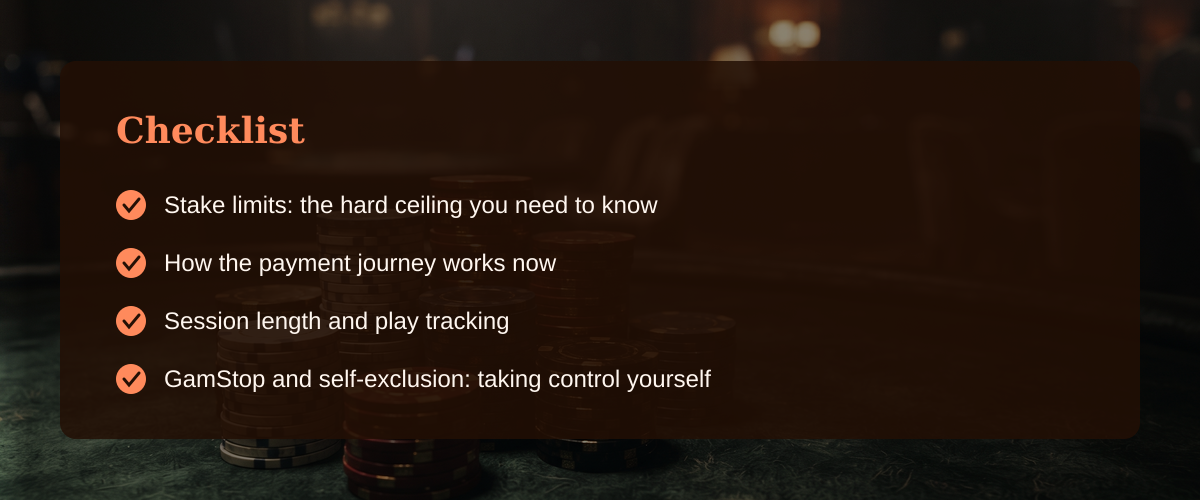
Stake limits: the hard ceiling you need to know
Let's be direct. As of April 2025, if you're 25 or older, the maximum stake per spin is £5. If you're between 18 and 24, it's £2 per spin, effective from May 2025. These aren't guidelines or recommendations—they're regulatory law. Every regulated operator licensed by the Gambling Commission must enforce them, full stop.
I'll admit this cost me money when I first butted up against it. I was used to spinning at £10 a go on some games, chasing bigger wins. One afternoon I went to place a £10 stake and got the error message. That's when reality hit: the industry had tightened, and my betting patterns had to shift with it. Some people welcomed the brake. Others, like me initially, felt the pinch.
The logic behind the age-tiered approach is that younger players face higher risk of harm, so the cap is stricter for them. The Gambling Commission's reasoning is publicly available, grounded in financial vulnerability data. Whether you agree with it or not, the limit is the law, and it applies to every licensed casino online slot site you'll find.
If you find yourself chasing losses by wanting to bet bigger, that stake limit might actually be your friend. It forces a pause, gives you time to step back and think. Use it that way.
How the payment journey works now

Depositing money to play slots online used to be simpler in theory, murkier in execution. Credit cards are now banned outright for online gambling in the United Kingdom. That's a massive change, and it means your options are more limited but arguably clearer.
The common deposit methods you'll actually use are:
- Debit cards—still the most straightforward route for most punters
- PayPal—instant, reversible, and widely supported
- Apple Pay—fast and cuts out typing card details repeatedly
- Paysafecard—a prepaid voucher that caps your exposure upfront
Each one feeds into affordability checks now, which is different from before. The Gambling Commission announced in 2026 a pilot scheme for financial vulnerability assessments—what they're calling "frictionless player protection checks." It sounds bureaucratic, but what it means is that operators are expected to look at your deposit patterns and flag if you're spending beyond what seems sustainable based on your account history and declared income. These checks aren't perfect, but they're a real addition to the system.
You'll also see deposit-limit prompts more often. An operator might suggest a daily or weekly cap before you even get into a game. Some players ignore these; some set them deliberately low as a self-imposed brake. The tools are there. Whether you use them properly is your call.
Session length and play tracking
Older casino online slot platforms were notoriously vague about how long you'd been playing. You'd sit down at 11 p.m. and look up at 3 a.m. with no real sense of time passing. The Gambling Commission has pushed hard to change that.
In the October to December 2025 quarter, online slots players recorded 25.7 billion spins across the market. That's a staggering number, but what's more telling is the session data. In Q3 2025, sessions lasting longer than one hour dropped to 8.9 million. That's not a coincidence—operators are now required to display session timers and prompt you to take breaks. Some sites are more aggressive about it than others, but it's standard.
The average monthly active player count for online slots was 4.6 million in Q3 2025, which gives you a sense of scale. This is mainstream activity now. But with that scale comes scrutiny, and scrutiny means visibility into your own play.
GamStop and self-exclusion: taking control yourself
If you reach a point where you think your slot play is getting out of hand, GamStop is the nuclear option and worth knowing about. It's a national self-exclusion scheme run across all Gambling Commission-licensed operators in Great Britain. You register yourself, and every licensed casino online slot site has to lock you out for a period you choose—minimum six weeks, up to five years.
It's free, it's immediate, and once you're in it, you can't get out early. That's the point. I've never used it personally, but I know people who have. They describe it as both a relief and a gut punch—relief because the temptation is gone, the gut punch because you realize how deep you'd gone before you hit the eject button.
GamStop covers only Gambling Commission-regulated operators. If you gamble on unlicensed sites—which I won't recommend—GamStop doesn't apply. Those sites sit outside the regulatory perimeter entirely, and you lose the protections that come with licensing.
The money flows and what they tell us
Looking at the data from the Gambling Commission's quarterly reports, you can get a real sense of the market. Online slots generated £745 million in gross gambling yield (that's the operator's revenue after payouts) in the April to June 2025 quarter. By October to December 2025, that had risen slightly to £788 million. These figures aren't trivial, and they reflect how embedded casino online slot play has become in British gambling culture.
The online gambling market as a whole brought in £1.49 billion in gross gambling yield in the spring quarter and £1.5 billion in the autumn quarter. Slots account for roughly half of that. The rest is split across table games like roulette and blackjack, poker, and sports betting.
These numbers matter because they show that the market survived the stake limit changes. Some predicted the restrictions would crater the industry. They didn't. Operators adapted, tweaked their game design and payout patterns, and play continued. The Gambling Levy Regulations 2025 came into force on 6 April 2025, and operators began paying the statutory gambling levy from 1 October 2025. That's a new tax on their revenue, passed partly on to players through tighter margins, but it's not killed the sector.
Choosing where to play: what licensed actually means
When you're looking for a casino to play online slots, the first question is whether they hold a Gambling Commission licence. You can verify this on the Commission's website. If they're licensed, they're operating under strict conditions: they hold the stake limits I mentioned, they run affordability checks, they display session timers, and they keep records that the Commission can audit.
Not all sites offering slots to British players are licensed. Some are operated from jurisdictions like Curacao, Cyprus, or Malta. These operators aren't subject to the Gambling Commission's rules, which means no stake limits, no mandatory affordability checks, and no GamStop integration. That sounds like freedom until something goes wrong and you've got no recourse. I've never been comfortable with that trade-off.
If you're looking at redneck spins casino or any other site, the first thing to check is the licence footer. It should clearly state it's licensed and regulated by the Gambling Commission. If it doesn't, you're playing in a regulatory grey zone, and I'd recommend moving on.
What changed, what stays the same
The RTP (return to player percentage) on slots hasn't changed—that's built into the game mathematics and isn't affected by regulation. The odds are still what they are. The house edge is still real. What's changed is the friction: the limits, the prompts, the cooling-off mechanisms. These don't stop you winning; they just slow down how fast you can lose.
Volatility matters just as much now as ever. A high-volatility slot will pump out long dry spells followed by sudden wins. A low-volatility slot dribbles out steady small wins. Your personal tolerance for swings should shape which games you pick. That decision-making capacity is still entirely yours.
Bonuses are still offered by most operators—deposit matches, free spins, loyalty schemes. Read the terms carefully. The stake limits apply to bonus funds too, and wagering requirements can be eye-watering. I've taken bonuses where the playthrough requirement was so stiff I knew I'd never clear it; the marketing looked glossy, but the math said no. Learn to do that math yourself before you claim.
The British gambling industry has evolved into something more regulated and arguably more player-aware than it was five years ago. Whether that's made it safer or just more controlled is a question every individual punter has to answer for themselves. What's certain is that if you play casino online slots through a licensed operator in Great Britain, you're operating inside a framework designed specifically to slow you down and make you think. Make use of that space.
