![[awatar]](/static/gen/avatars/coltonriley/m0.png?2 "ColtonRiley")
A new online casino no deposit bonus always gets attention over here, and I get why. If you’re in Great Britain, a free starting offer sounds neat on paper, but the real value only shows up when you look at the licence, the wagering rules, the game limits, and the payment flow that fits everyday life here. Debit cards, PayPal, Apple Pay and Paysafecard are the sort of methods most of us recognise straight away, so the bonus feels less like a gimmick when the cashier is built around familiar UK habits.
There’s also a proper local angle to this. British players are used to GamStop, affordability checks, and the UK Gambling Commission, so a no deposit offer is never just about the free spins or bonus cash. It’s about whether the operator is playing by the rules that govern remote casino play in Great Britain, and whether the offer makes sense alongside football bets, a day at the races, or a quick session after work with the telly on in the background.
“No deposit bonus” is a common marketing term, but it doesn’t mean free and easy with no strings at all. Usually, the offer comes with promotional terms and conditions, and those terms matter much more than the headline. If you know how those conditions work, you can judge the offer properly instead of getting carried away by the word “free”.
What does a no deposit bonus really mean?
A no deposit bonus is exactly what the phrase suggests: a casino offers a promotion without asking for an initial deposit. In the GB market, that can mean bonus funds, free spins, or another starter perk attached to an account before any money goes in. The appeal is obvious, because you get a taste of the site without opening your wallet first.
That said, the offer is rarely as simple as it looks in the banner. UK bonus offers are usually covered by promotional terms and conditions, and those terms often include wagering requirements, game restrictions, stake caps, and time limits. The moment you know that, the whole thing becomes easier to read.
Wagering requirements are the bit many people skim past, then regret later. If the bonus needs to be played through a certain number of times before withdrawal, the real value drops fast if you’re not careful about the games you choose. Slot restrictions can matter too, because some titles may contribute fully while others barely count.
There’s another small but useful detail here: a remote casino is the common regulatory term for online casino gambling in Great Britain. That matters because the market here isn’t the same as some offshore setup with loose rules and fuzzy wording. A site serving GB players should hold a Gambling Commission licence, and that licence carries the weight of the UKGC framework behind it.
So the bonus is not just a freebie. It’s a regulated promotional product, and if you treat it that way, you’ll make sharper choices. That’s the sensible way to handle it, especially when you’re trying a new site for the first time.
Which rules shape GB casino offers?
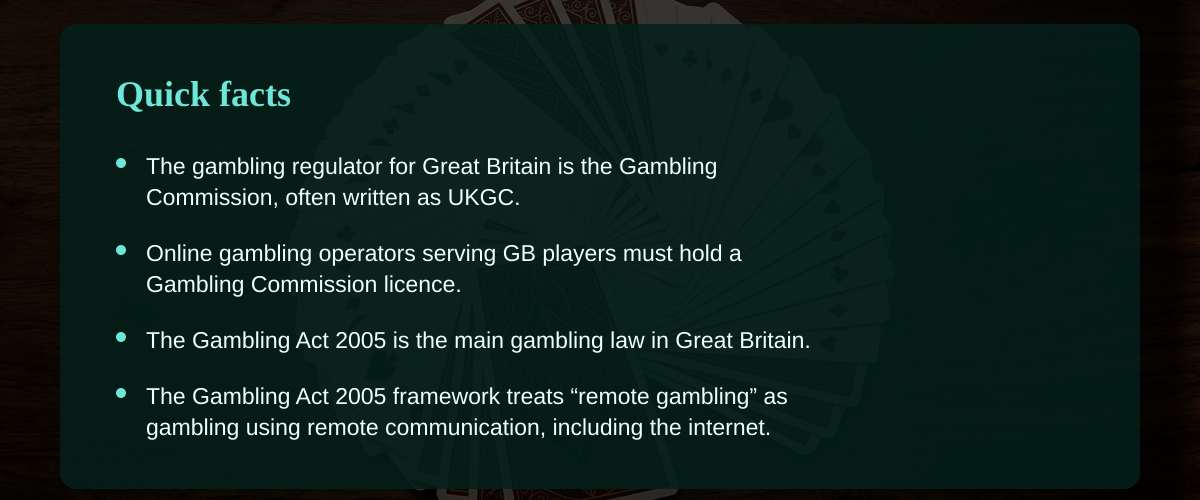
Great Britain’s gambling setup is built around the Gambling Act 2005, and remote gambling falls inside that framework as gambling using remote communication, including the internet. The Gambling (Licensing and Advertising) Act 2014 pushed remote operators targeting GB players into the UK licensing regime, so online casinos can’t just turn up and market to us without the right permission.
The UK Gambling Commission, usually shortened to UKGC, is the regulator to keep in mind. If an online casino serves GB players, it must hold a Gambling Commission licence. That is the baseline, not a bonus point, and it’s the first thing I check before I even think about a promotion.
Promotional offers then sit under the operator’s terms, but the safer gambling side is part of the same picture. Operators must offer tools such as deposit limits, time-outs and self-exclusion, and GAMSTOP is the national online self-exclusion scheme for GB-licensed gambling websites. That link between the bonus and the player-protection setup is easy to miss, yet it’s central to how the market works here.
Affordability checks also sit in the background more than many people expect. They can feel a bit bureaucratic at the time, but they are part of the GB reality now, and if a site is asking sensible questions before letting you move money around, that’s not some random annoyance. It’s part of the regulated environment we all play in.
The broader market context is worth a glance too. The Gambling Commission reported £16.8 billion in total gross gambling yield in Great Britain for April 2024 to March 2025, with online gambling generating £7.8 billion in the year to March 2025. Remote casino, betting and bingo accounted for 46% of Great Britain gambling gross gambling yield in that same period, which tells you how central online play has become for local punters.
How do payment methods and local habits affect the offer?
In GB, the cashier has to feel familiar if a new casino wants to earn trust. Debit cards are still the default for a lot of players, and PayPal, Apple Pay and Paysafecard are all well-known names in the mix. That matters because a slick-looking bonus starts to look a lot less friendly if the payment page feels awkward or cluttered.
Local habits shape the way we assess value too. A lot of us will compare a casino offer with the sort of money we might otherwise put on football or horse racing, especially at the weekend when the fixtures and the cards are all over the place. The bonus does not need to copy a sportsbook mood, but it does need to feel useful enough that the extra steps make sense.
The UK market is also very clearly split between online and in-person play. The Gambling Commission’s 2025 Great Britain survey reported that 38% of participants gambled online in the past 4 weeks, while 28% gambled in person in the same period. That gap helps explain why remote casino offers get so much attention here: they’re part of everyday gambling life, not some side niche.
When I look at a no deposit bonus, I always think about how the cashier and the offer work together. If I can top up with a debit card or use PayPal without fuss, and the promotion terms are straightforward, the site feels better built for the GB market. If it only looks generous on the banner, I’m less interested.
One sensible example is the kind of first impression you might get from a site like wager palace casino, where the broader question is not just whether a bonus exists, but whether the structure around it matches how players here actually move money and manage a session. That is the sort of practical fit that matters more than shiny language.
What do the terms usually do to the value?
Promotional terms are where a no deposit bonus either becomes useful or shrinks into a token gesture. Wagering requirements are the obvious piece, but game restrictions can be just as important, because some bonuses only count on selected slots or specific categories of games. If you’re the kind of player who likes to jump between titles, that can make a real difference.
Expiry times also matter. A bonus that needs to be used quickly can be fine if you play often, but if you only dip in now and then, the value can disappear before you’ve had a proper go. That’s why the word “free” never tells the full story.
There can be stake restrictions as well, and in the UK the wider regulatory picture has tightened around online slots. The Gambling Commission introduced new online slots stake limits in 2026, with the £5 maximum stake for online slots for all adults going live on 9 April 2025, and the £2 maximum stake for adults aged 18 to 24 going live on 21 May 2025. Those limits are not the same thing as bonus rules, but they shape the way online play feels in practice.
That’s especially relevant for players who use free offers to test a site before depositing. If the bonus pushes you into a game set you would not normally choose, or if the stake cap changes the rhythm of play, the offer can feel very different from the marketing copy. I think that’s a fair thing to keep in mind, especially for younger adults who are already working within the tighter slot rules.
There’s also a bigger financial picture behind these promotions. British gambling winnings are generally not taxed for players, though operators can be liable for gambling duties and taxes. That can make the headline of a bonus feel more attractive, but it doesn’t replace the need to read the terms properly. The practical value still depends on how the bonus is structured.
How should a new player judge safety before claiming anything?
The cleanest check is still the licence. If the operator does not hold a Gambling Commission licence, I would not treat the bonus as worth the bother, whatever the headline says. The UKGC licence is what anchors the whole thing to the GB system, and it’s the piece that separates a legitimate remote casino from a site I’d rather leave alone.
After that, I look at the safer gambling tools. Deposit limits, time-outs and self-exclusion are standard now, and that’s not just box-ticking. These tools are part of the way a regulated GB casino is supposed to work, and they matter even more when a promotion is designed to get you started quickly.
GamStop deserves a direct mention here because it changes the real world for players, not just the paperwork. If someone has signed up to self-exclude, GB-licensed websites are supposed to respect that. A no deposit bonus does not sit outside that system, so the offer never overrides the player-protection side of the market.
Affordability checks can feel like the least glamorous part of the experience, but they exist for a reason. If a casino asks for a little more detail before letting you go further, that is usually part of the compliance process rather than a sign that something has gone wrong. In a market this large, with online gambling generating £7.8 billion of gross gambling yield in the year to March 2025, those controls are part of the landscape.
The land-based side still matters too, even in a digital discussion. The non-remote land-based sector accounted for 29% of Great Britain gambling gross gambling yield in the year to March 2025, and licensed lotteries, including the National Lottery and society lotteries, accounted for 25%. That mix is a good reminder that the UK market is broad, but the new online casino no deposit bonus sits firmly in the remote end of it.
When does a free offer make sense for British players?
A free offer makes sense when it gives you a proper look at the site without creating noise around the decision. If the licence is in place, the terms are readable, and the payment methods suit how you already handle money, then a no deposit bonus can be a tidy way to test the waters. It is a practical check, not a promise of easy value.
The offer also needs to fit the rhythm of British play. A lot of local punters split attention between football, horse racing, and a bit of casino action in quieter moments, so the best bonus is the one that does not force a weird routine. If it lets you explore the lobby and understand the games before you commit a pound, that is a decent start.
There’s a reason these offers are talked about so often in the UK. Remote gambling is already a major part of the market, and the 2025 survey data makes that obvious enough. When 38% of participants are gambling online in the past four weeks, the first impression of a new operator carries more weight than it might in a smaller market.
What I like most about a well-structured no deposit bonus is the breathing room it gives. You can see whether the site loads properly, whether the cashier feels right, and whether the game selection matches your taste before making a deposit. That is especially useful if you prefer to use familiar options like debit cards or PayPal, or if you want to keep things simple with Apple Pay or Paysafecard.
There is still a line between a useful free trial and a flashy distraction, and the line is usually in the terms. If the promotion is clear, the rules are realistic, and the casino is UKGC-licensed, the offer can be worth a look. If not, there are plenty of other places to spend your time on football, the horses, or a different remote casino that handles the basics better.
For GB players, the smart move is to treat a new online casino no deposit bonus as a test of fit, not a shortcut. Check the UKGC licence, read the bonus terms, use the safer gambling tools if you need them, and keep GamStop in mind if self-exclusion is part of your situation. That’s the sort of grounded approach that works well in this market, and it keeps the free offer in its proper place.
